https://www.youtube.com/watch?v=STkh15nZ1uA
Powerful acting by a favorite in this short piece → Michael K. Williams Asks: Am I Typecast?
https://www.youtube.com/watch?v=STkh15nZ1uA
Powerful acting by a favorite in this short piece → Michael K. Williams Asks: Am I Typecast?
Every Aboriginal newborn is assigned a ‘tjukurpa’ — a story from the time of the world’s creation which, in its details, will tell them everything they need to know about where to find food, medicine and water for hundreds of miles around. It will teach them about magic and spirits and detail an elaborate moral code. A tjukurpa is a cross between a Bible parable, a Just So story, a supermarket plan and a travel guide. It is a multi-dimensional map of life that speaks of time, space and meaning. Events in the story’s plot — battles and birthplaces and hideouts — correspond to actual facets of the physical landscape, so you will know that you can find carrots, for instance, in the spot where the bush carrot beat the bush potato in a fight. Tjukurpas are incredibly complex. They are taught in stages, with each new level of detail being revealed by elders when an individual is considered ready. They are imparted in as many ways as possible: dance, song, body-painting, rock-carving and sand-drawings that cover a hectare. But they are highly secret. They are passed down strictly between members of the same ‘skin group’. Men do not know the women’s tjukurpas, and women do not know the men’s. White people have only ever been told as much as the youngest Aboriginal children. The paintings that artists such as Shorty produce are highly codified and obscured, so that their tjukurpas remain hidden. But they are all based on these essential, ancient lessons.
It is said that the Australian Aboriginals belong to the oldest surviving culture on earth. It appears profoundly different from ours. But I have come to believe that, in one crucial sense, we are just like the Aboriginals. We share their means of negotiating reality. Our lives, to an almost unimaginable degree, depend on stories.
—Will Storr
—from The Unpersuadables: Adventures with the Enemies of Science
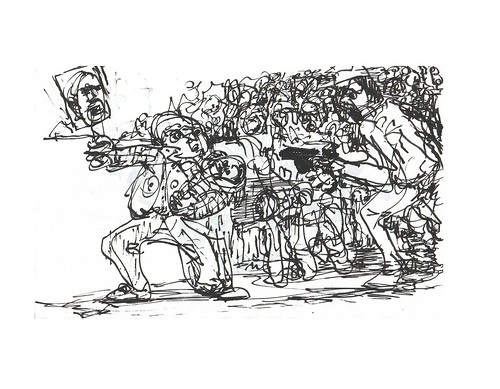
garboil / garboyle /GA(R)-boil/. noun. A tumult; a confusion; a commotion; an uproar; a hubbub; a hurlyburly. From Old Italian garbuglio (a tangle, a mess) < possibly from Latin bullīre (to boil).
“Far from the moiling crowd and garboyle of the world.” (The National Review)
“Yet others have disappeared, snatched from their places of refuge, to vanish into the prisons of the Exfernal Powers, denied trial, forbidden even to know the names of their accusers. Their minds may already have been destroyed by drugs and torture, their bodies melted into garboil.” (Margaret Atwood)
“…the most terrifying din and the principal uproar arises from the anguished howls of the devils, who, lying in wait in that confused garboil, receive chance blows from swords and suffer ruptures in the continuity of their substances, which are both aerial and invisible.” (Francois Rabelais)
“Then in ’82 there had been the Egyptian garboil I mentioned a moment ago; Joe Wolseley had asked for me point-blank, and with the press applauding and the Queen approving and Elspeth bursting into tears as I rogered her farewell, what the blazes could I do but fall in?” (George MacDonald Fraser)
“‘You have been grievously in error this day, sir. You have handed the throne of England to a malodorous Scotch garboil—or perchance a simpering Spaniard.’” (Rory Clements)
“…all Greece stood in marvellous garboil at that time, and the Athenians especially in great danger.” (Sir Thomas North)
“So much uncurbable, her garboils, Caesar,
Made out of her impatience…”
(William Shakespeare)
“Now manhod and garbroyls I chaunt…” (Richard Stanyhurst)
I’m an unashamed member of #TeamSpeed when it comes to most audiobooks and podcasts. I am not alone in this ‘overclocking’.
There’s something beautifully weird and obsessive about Waclaw Szpakowski’s “labrynthine” single-line drawings.
Speaking of the beautiful weird, have a listen to Emil Amos’ Drifter’s Sympathy show.
Play The Great Language Game and see what languages you recognize.
Browse The Food Lab’s Top 30 Hot Sauces. My favorites are all in there except WUJU. Any others missing?
Thanks, Reader B. for sharing an intriguing story On Dracula’s Lost Icelandic Sister Text.
From Reader C., some links that should convince even the crustiest Clamorites that Twitter can be useful: @medievalpoc, featuring fascinating information about people of color in European Art History, and @discarding_imgs, routinely sharing tasty medieval images.
Remembering Nüshu, the 19th-Century Chinese Script Only Women Could Write
It’s a good day for sweets and the sweetums who love ’em: on this day in 1906, Kellogg’s is founded as the “Battle Creek Toasted Corn Flake Company,” an offshoot of the Kellogg brothers work at a religion-based sanitarium (T.C. Boyle’s fabulous book Road to Wellville is based on this history); today in 1913, more than 100 years after its debut, Cracker Jack began putting toys in their tasty, eponymous product; and today in 1985, Cherry Coke is rolled out to the public a few years after a very successful taste test at the 1982 World’s Fair in Knoxville, Tennessee.
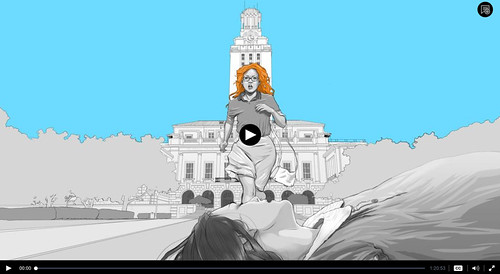
Available for streaming this month only, TOWER is a riveting—partially animated and partially live action—look into the infamous 1966 University of Texas Tower shooting.

“First and foremost, I, Luna Cobra, am the inventor of eyeball, or sclera, tattooing (tattooing the white of the eye in a solid or mix of colours). I first attempted the procedure on sighted human eyeballs in 2007 on three well-informed and consenting parties. Since then, I have fine-tuned both the technique and materials to increase the safety and minimize the risks of tattooing the eyeball.”